


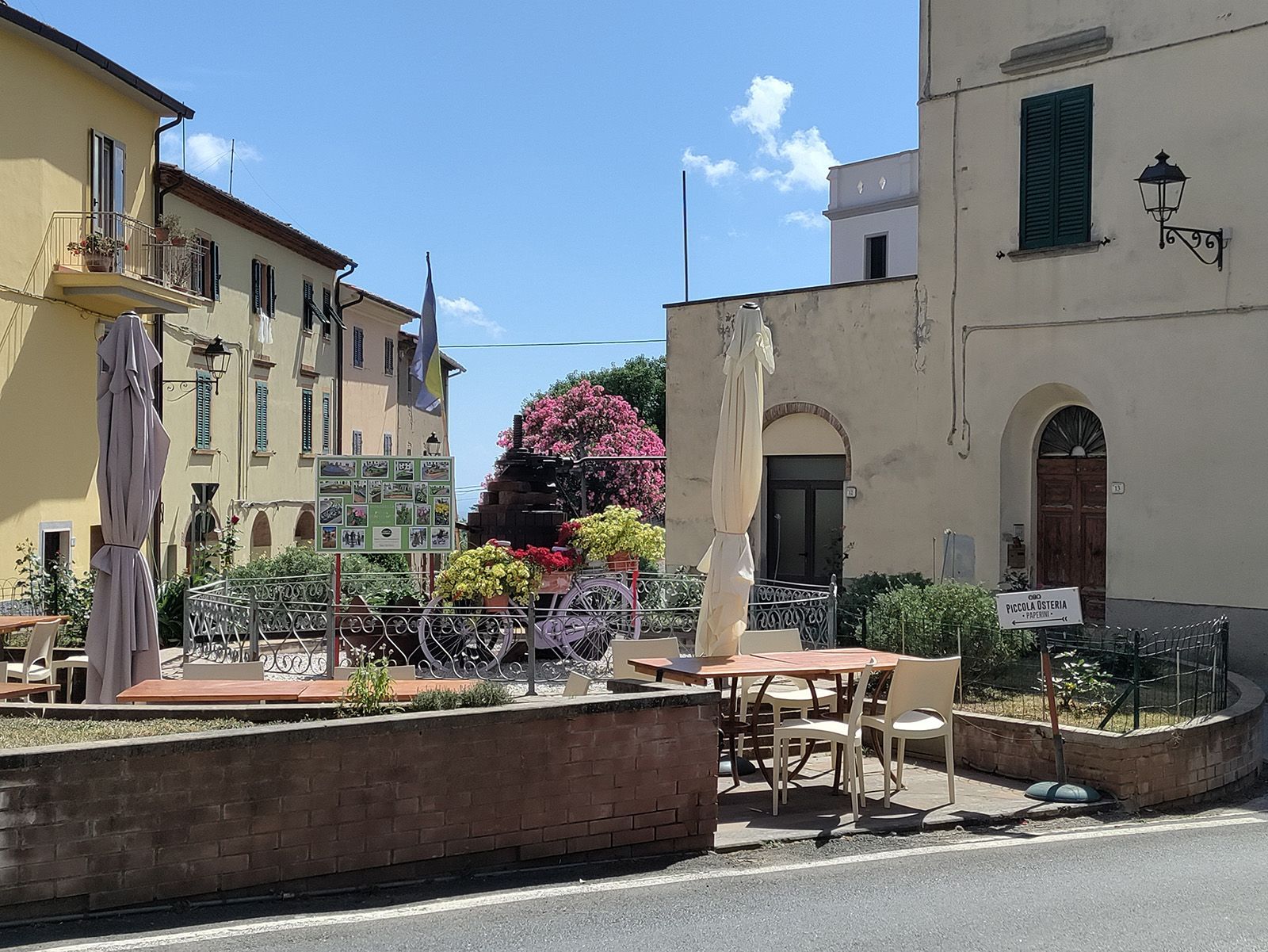
Piazza Federico Baldasserini.
Created in the second half of the nineteenth century, today it holds the Fontana all’Ulivo, a mural in bold, solid colours and the raised garden bed tended by resident volunteers.
The square was created around the second half of the nineteenth century and is named after the scion of one of the Pisan families with property in the town.
The Baldasserini family
The Baldasserini family had held property in the Riparbella area and in the town since the eighteenth century: among these San Pecoraio, San Martino and the oratory dedicated to the Madonna del piano. The private chapel of the Antico Borgo San Martino belongs to the same family.
The Fontana all’Ulivo
At the centre of the square, in the shade of an olive tree, stands the Fontana all’Ulivo : two parallel blocks carrying, on the front and on the back, iconic elements of the area. On one slab is engraved a road lined with cypresses leading to a typical Tuscan house and a medieval tower; on the other an ear of wheat and a vine with its grapes, the two harvests that made the fortune of the Val di Cecina. Like many fountains in old towns, it was created to make up for the lack of running water in the houses and later became street furniture.
Adotta Riparbella
Today the square holds a raised garden bed of flowers entirely tended by resident volunteers, and has become the symbol of the “Adotta Riparbella” project. On the façades, the mural Terra e colori by Mina Hamada and Zosen Bandido.
Old town, towards the southern entrance to the town.
Always accessible, free admission.
Terra e colori by Zosen Bandido and Mina Hamada, 2024.
Texts by the Riparbella tourist office and the portal visitriparbella.com. The Fontana all’Ulivo is described by Visit Valdicecina. Page updated July 2026.