


Piazza del Popolo.
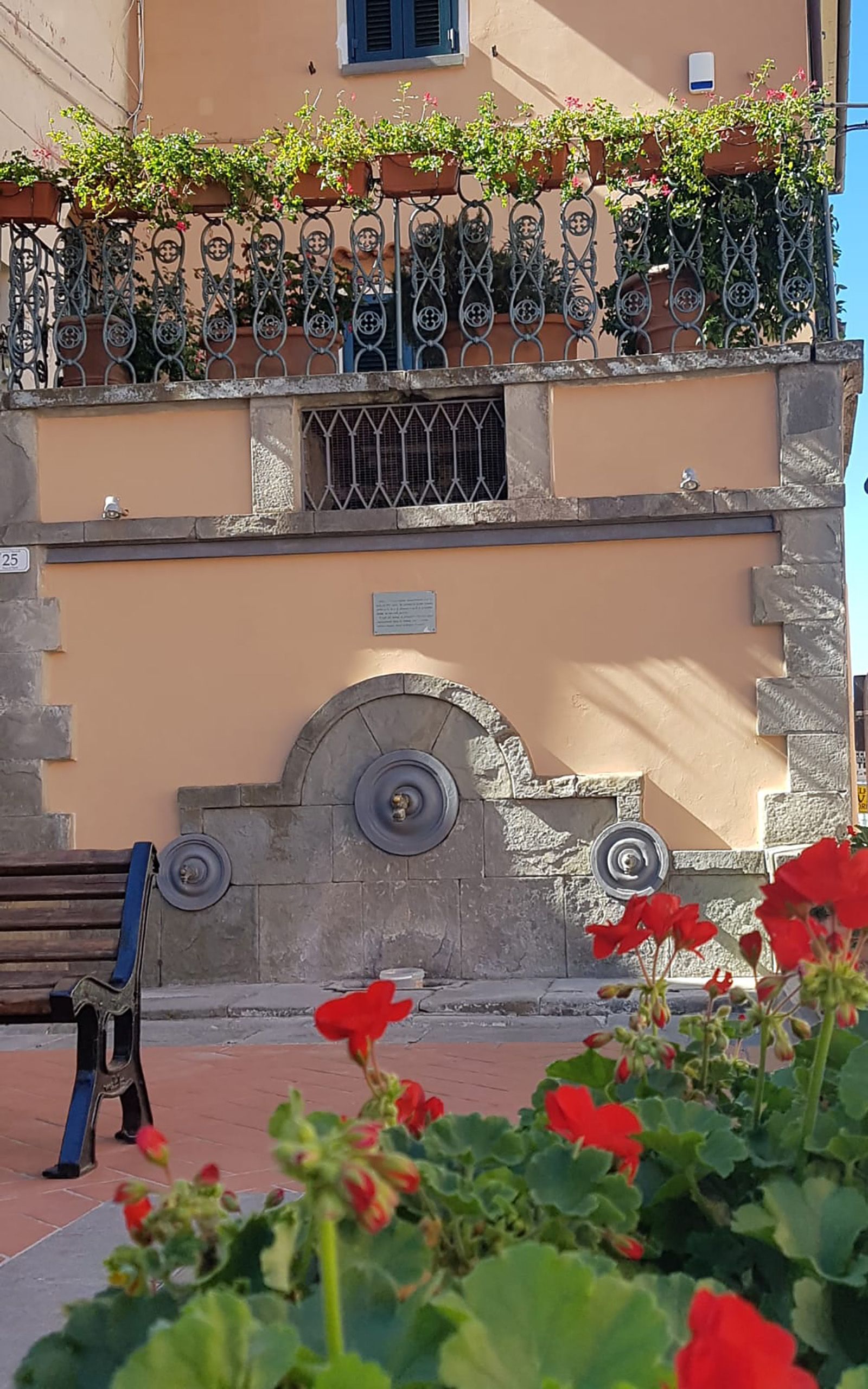
Beneath the paving lie the remains of the great cistern of 1636, built at the behest of the Marquis Carlotti. Of the old spring the three spouts survive.
Piazza del Popolo was the town centre, and its main spring stood here. Beneath the paving lie the remains of the great cistern of 1636 , built at the behest of the Marquis Carlotti: of the old spring the three spouts survive, and water still runs from them.
The spring that opened on Saturdays
The cistern was crowned by a spring that was opened every Saturday so that the townspeople could draw water. In 1859 that great spring was replaced by another, a monumental one in bronze, later melted down during the war under Fascism. The Town Hall and the “farm” look onto the square.
The Piazza Grande
In the early nineteenth century the square was called Grande , like the street that led to the church of San Michele, today San Giovanni Evangelista. At the centre the farm of 1484, and around it the houses of the families who under the Grand Duchy and the Marquis Carlotti guided the fortunes of the town.
In the same square, from as early as the end of the seventeenth century, there stood a clock — which marked the hours until the middle of the nineteenth century — and a sundial set on the Palazzo degli Stefanelli. Another cistern stood in the courtyard of the Giusteschi house, another family present in Riparbella since the sixteenth century.
Cholera and drinking water
In 1836 Riparbella was struck by a cholera epidemic, a disease caused by drinking contaminated water, which claimed many lives and returned in 1855. In 1858 drinking water was finally brought to the town, and the population consequently grew to 3,793 inhabitants.
Old town. The Town Hall, the library and the Pro Loco all look onto it.
Always accessible.
Pro Loco tourist office, Piazza del Popolo. Tel. 333 1691023
· proloco.riparbella@gmail.com
Municipality of Riparbella, tel. 0586 697111.
Texts by the Riparbella tourist office and the portal visitriparbella.com. Page updated July 2026.