


The monumental cemetery.
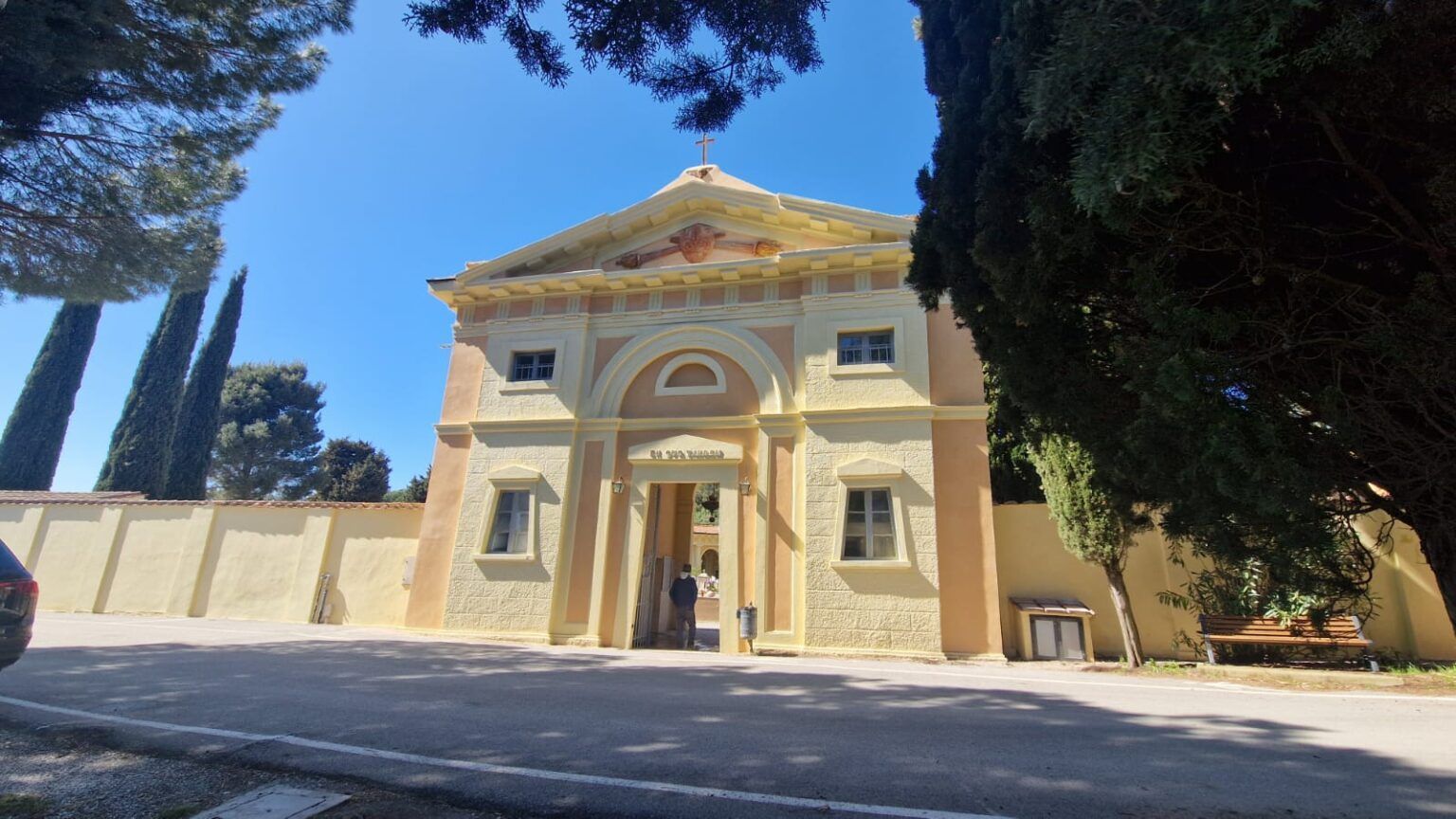
A national monument since 1989, an early work by Luigi Bellincioni. A neoclassical portico that embraces the burial ground in a semicircle and never encloses it.
Just outside the town, along the road towards Castellina, is one of the most moving places in Riparbella: the Bellincioni monumental cemetery, declared a national monument in 1989. It is an early work by the architect Luigi Bellincioni, designed in 1884 and completed in 1894.
A doorway that quotes Etruscan tombs
The doorway on the façade echoes the shape of the jambs of Etruscan tombs and is crowned by the Florentine lily with two torches pointing downwards, an ancient Etruscan symbol of death. Beyond the entrance opens a majestic neoclassical portico that embraces the burial ground in a semicircle, on an octagonal plan.
The work was left unfinished — in the design the arcades were meant to close the full circle — and it is precisely those open sides that give it an atmosphere of rare spirituality. Under the portico, opposite the entrance, stands the chapel, which takes up the motif of the Etruscan jambs; on either side are the mortuary chambers, the municipal niches and the chapels of the town’s most influential families.
Why Riparbella turned to Bellincioni
Its story begins at the end of the nineteenth century, when Riparbella found itself in need of a new burial ground: the existing one no longer met the health and hygiene requirements laid down by post-unification legislation. The Municipality then chose an ambitious course, entrusting the design — drawn up in 1884 — to Bellincioni, one of the most respected figures in Tuscan public architecture of the day.
A building site that lasted thirty years
The building works, begun in 1887, were not straightforward: the first contractor abandoned the site after only a few months, and the local craftsmen who took over were not always equal to the original design. With the outbreak of the First World War the site slowed down further, leaving the work unfinished compared with the design: not all the chapels were built, and some corners of the loggia were completed only decades later.
For many years the cemetery remained like this — unfinished but fully lived in by the community — until recent decades when, in particular from 2017 onwards , a programme of restoration and enhancement was set in motion. The most recent works, funded by the Tuscany Region, involved conservation repairs to the plasterwork of the loggias and porticoes, new burial niches, the removal of architectural barriers and the creation of a historical documentation area with material from the municipal archive. In earlier years the Municipality had built a new perimeter wall, repaved the main avenue, created the car parks and adopted regulations for the upkeep of the site.
Getting there
It stands at the entrance to the town on the Castellina side, along Via del Commercio, with free parking in front. Passing by here too is Trail no. 1 “Ripa Bella”, and starting near the cemetery is Trail no. 2, the one to the spring at the wooden bridge.
At the entrance to the town on the Castellina side, on Via del Commercio. Free parking.
Accessible during the cemetery’s opening hours. It is a working cemetery: please visit with respect.
The trails no. 1 and no. 2 run by the Municipality.
Texts by the Riparbella tourist office and the portal visitriparbella.com. Checked against Visit Valdicecina and against the regeneration works funded by the Tuscany Region ( Visit Cecina). Page updated July 2026.